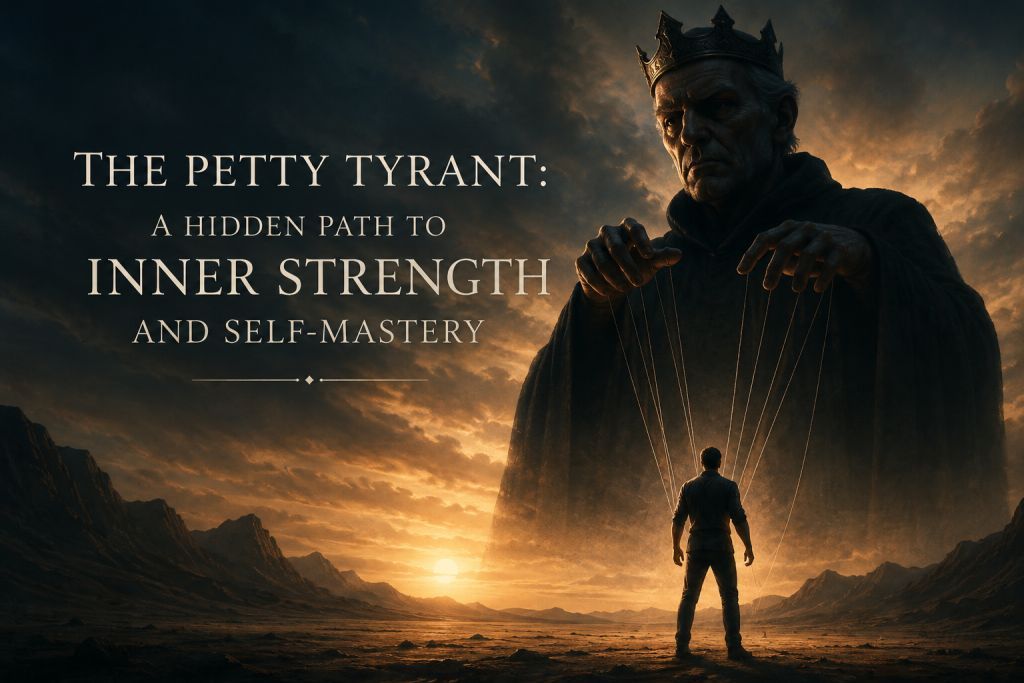

Introduction – What Is a “Petty Tyrant”?
Throughout our lives, we inevitably encounter people who test our patience, emotional balance, and inner resilience. They may be a demanding manager, a critical family member, a manipulative colleague, or anyone whose behavior consistently challenges our peace of mind.
Most of us see these individuals as obstacles.
Yet within several esoteric and initiatory traditions, they are viewed quite differently: as unexpected teachers.
The concept became widely known through the writings of Carlos Castaneda, in which Don Juan introduces the idea of the Petty Tyrant—one of the most thought-provoking and controversial teachings found in his books.
Whether one considers Castaneda’s works to be literal accounts of spiritual apprenticeship, symbolic narratives, or philosophical literature, the underlying principle has influenced many modern approaches to personal development, mindfulness, and psychological growth.
The Teaching of the Petty Tyrant
According to Don Juan, a Petty Tyrant is someone who:
- intimidates us,
- dominates us,
- provokes fear,
- constantly irritates us,
- or repeatedly challenges our emotional stability.
Our natural reaction is usually to resist, fight back, or escape.
The teaching proposes a radically different perspective:
Instead of seeing these people solely as enemies, we can use them as instruments for cultivating awareness, discipline, and inner freedom.
Real strength rarely develops when life is comfortable.
It is forged through challenge.
A Universal Principle Across Spiritual Traditions
Although the expression “Petty Tyrant” comes from Castaneda’s writings, the underlying wisdom appears in many philosophical and spiritual traditions.
Similar ideas can be found in:
- Stoicism,
- Buddhism,
- Taoism,
- Western esoteric schools,
- and even within Christian contemplative traditions.
Each of these paths points toward a similar insight:
The external adversary reveals the inner self.
They do not create our anger.
They expose it.
They do not create our fear.
They reveal where it already exists.
The Psychological Perspective
From a psychological standpoint, difficult people often activate what therapists call emotional triggers.
Every intense emotional reaction contains valuable information.
It may point toward:
- fear of rejection,
- the need for control,
- the desire for approval,
- unresolved emotional wounds,
- or deeply rooted beliefs about our own worth.
In this sense, the Petty Tyrant functions like a mirror.
They do not necessarily reveal who they are.
They reveal what within ourselves still seeks healing, awareness, and integration.
The Astrological Perspective
Psychological astrology offers another symbolic way of understanding these encounters.
Certain planetary archetypes often become activated during challenging relationships.
Saturn
Saturn represents responsibility, maturity, discipline, and life’s difficult lessons.
Many of the people who challenge us act as Saturnian teachers, encouraging us to develop patience, boundaries, and resilience.
Pluto
Pluto governs power, control, transformation, manipulation, and profound psychological change.
A Petty Tyrant often activates Plutonian themes, forcing us to confront issues surrounding personal power and emotional control.
Chiron
Sometimes another person’s behavior touches an old wound that has never completely healed.
The wound was already there.
The encounter simply brings it into consciousness.
Mars
Mars teaches us how to defend our boundaries with courage—not through aggression, but through healthy assertiveness and self-respect.
Shadow & Light
The Shadow
One important clarification must be made.
This teaching does not encourage people to:
- tolerate abuse,
- remain in toxic relationships,
- accept violence,
- or justify manipulative behavior.
Healthy spiritual growth never replaces healthy personal boundaries.
Sometimes the wisest decision is simply to leave.
The Light
However, when a difficult situation cannot be avoided, it may become an opportunity for conscious practice.
Each time we:
- remain calm,
- respond instead of react,
- preserve our dignity,
- choose awareness over impulse,
we strengthen something far more valuable than external control:
our inner freedom.
The Greatest Battle Is Within
Nearly every authentic initiatory tradition points toward the same realization:
Our greatest opponent is rarely another person.
It is our own unconscious mind.
Our fear.
Our pride.
Our attachment to being right.
Our need for validation.
Our desire to control.
The Petty Tyrant merely illuminates these hidden aspects of ourselves.
Coaching Perspective – Practical Self-Reflection
The next time someone deeply upsets you, pause before reacting.
Ask yourself:
- What exactly has been triggered within me?
- Why does this situation affect me so strongly?
- Which part of myself is asking for attention or healing?
- How can I protect my boundaries without losing my inner balance?
Self-awareness does not mean never feeling anger.
It means refusing to let anger dictate our actions.
Reflection Prompt
Who is the “Petty Tyrant” in my life today, and what might this person—perhaps unintentionally—be teaching me about myself?
An Important Note
The concept of the Petty Tyrant, as presented in the works of Carlos Castaneda, belongs to a broader symbolic and initiatory narrative whose historical and anthropological accuracy has been widely debated. This article approaches the idea as a philosophical and psychological metaphor for self-awareness and personal growth rather than as a historically verified spiritual doctrine or an invitation to tolerate abusive behavior.
Conclusion
Perhaps true spiritual growth does not begin in moments of comfort, but in moments of challenge.
When life places difficult people on our path, we always have a choice.
We can react automatically, allowing circumstances to control us.
Or we can transform every challenge into an opportunity for greater awareness, maturity, and inner freedom.
The Petty Tyrants of our lives are not role models, nor are they people we should admire.
They are, perhaps, unexpected mirrors revealing where our deepest work still remains.
And sometimes, behind our greatest challenges, we discover the strongest version of ourselves.
Request Your Personalized Psychological Astrology Reading
Do recurring relationships, conflicts, or life situations seem to trigger the same emotional patterns over and over again?
Your natal chart may offer profound insight into why these experiences continue to appear and what they are inviting you to learn.
Through a personalized written Psychological Astrology consultation, we explore the archetypal dynamics shaping your life, uncover recurring themes, and identify practical pathways toward greater self-awareness, emotional resilience, and personal transformation.
Because sometimes our greatest teacher is not the one who comforts us—but the one who quietly invites us to become who we are truly meant to be.
We Will Return to This Topic
The teaching of the Petty Tyrant is far too profound to be explored in a single article. In future publications, we will revisit this subject through the lenses of psychology, psychological astrology, and the world’s initiatory traditions.
Perhaps the greatest lesson of this teaching is that our true opponent is rarely the person standing before us. More often, it is our own ego, self-pity, attachment to being right, and the image we struggle to protect.
As long as these forces govern us, every challenge feels like a threat.
But as we gradually transcend them, we discover an inner strength that no longer depends on external circumstances.
As many initiatory traditions symbolically suggest, once a person is no longer ruled by ego and self-pity, they become extraordinarily difficult to defeat, because no one can truly dominate their inner world.